


Personal property · Loss reports · ACV schedules
A priced contents inventory, without typing a single line.
Indemnia builds a documented record of what you own from the receipts already sitting in your inbox, so a claim runs on evidence instead of memory.
It's free to begin, and there's no card. A demo is thirty minutes, screen shared.
Built for homeowners, public adjusters and restoration firms, anywhere in the country
What it does
Four things that turn a pile of stuff into a documented record
The receipts are already in your inbox
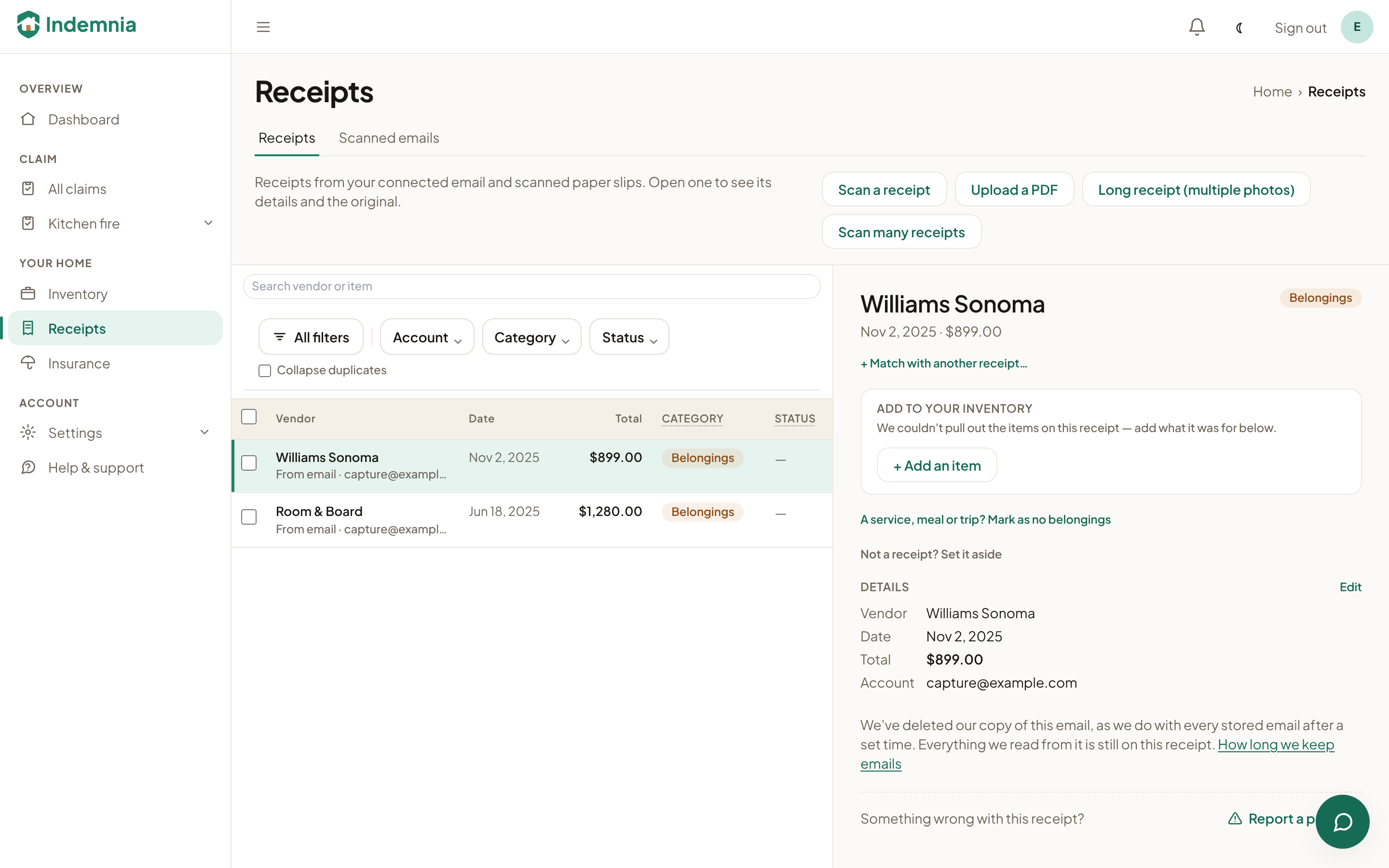
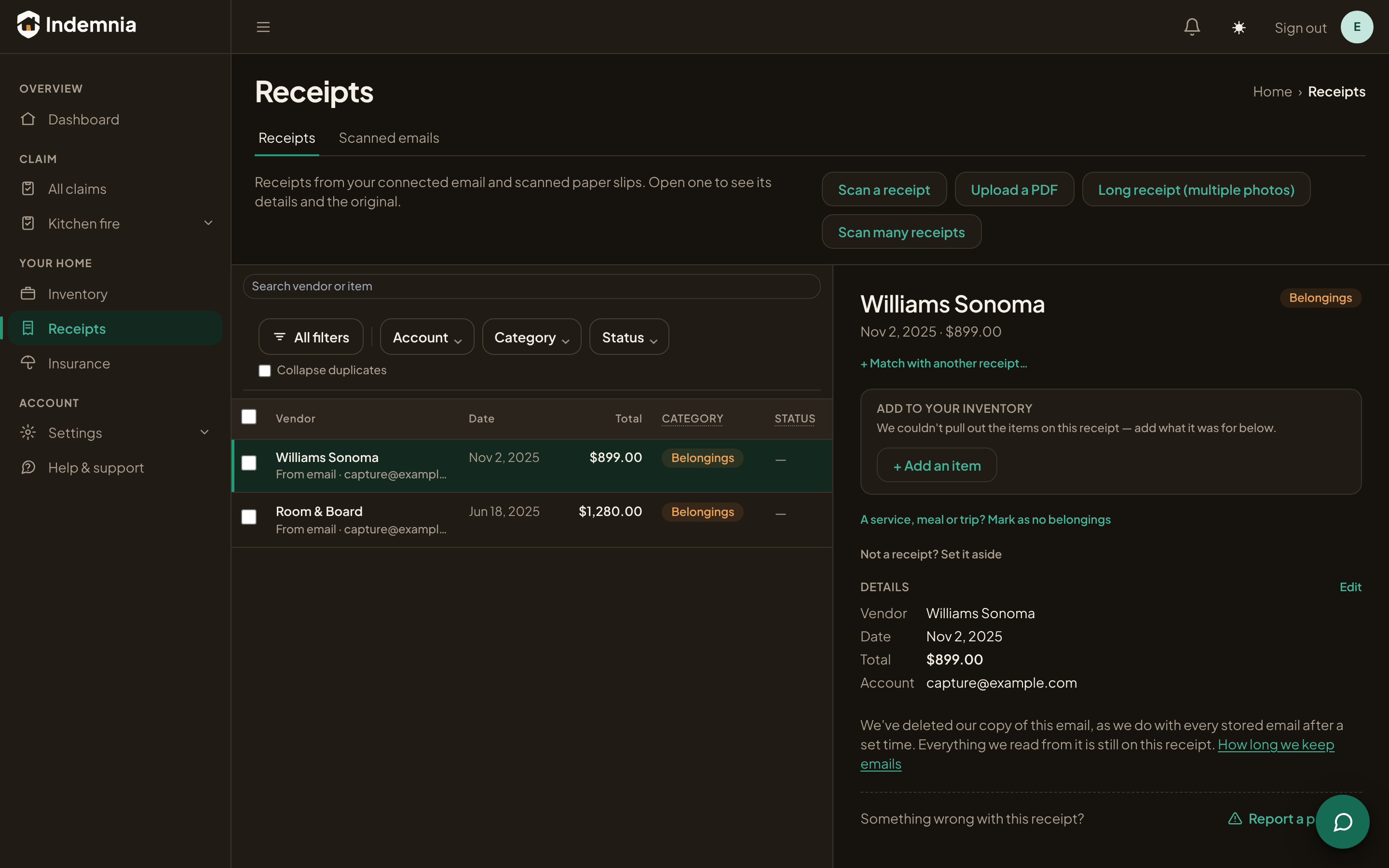
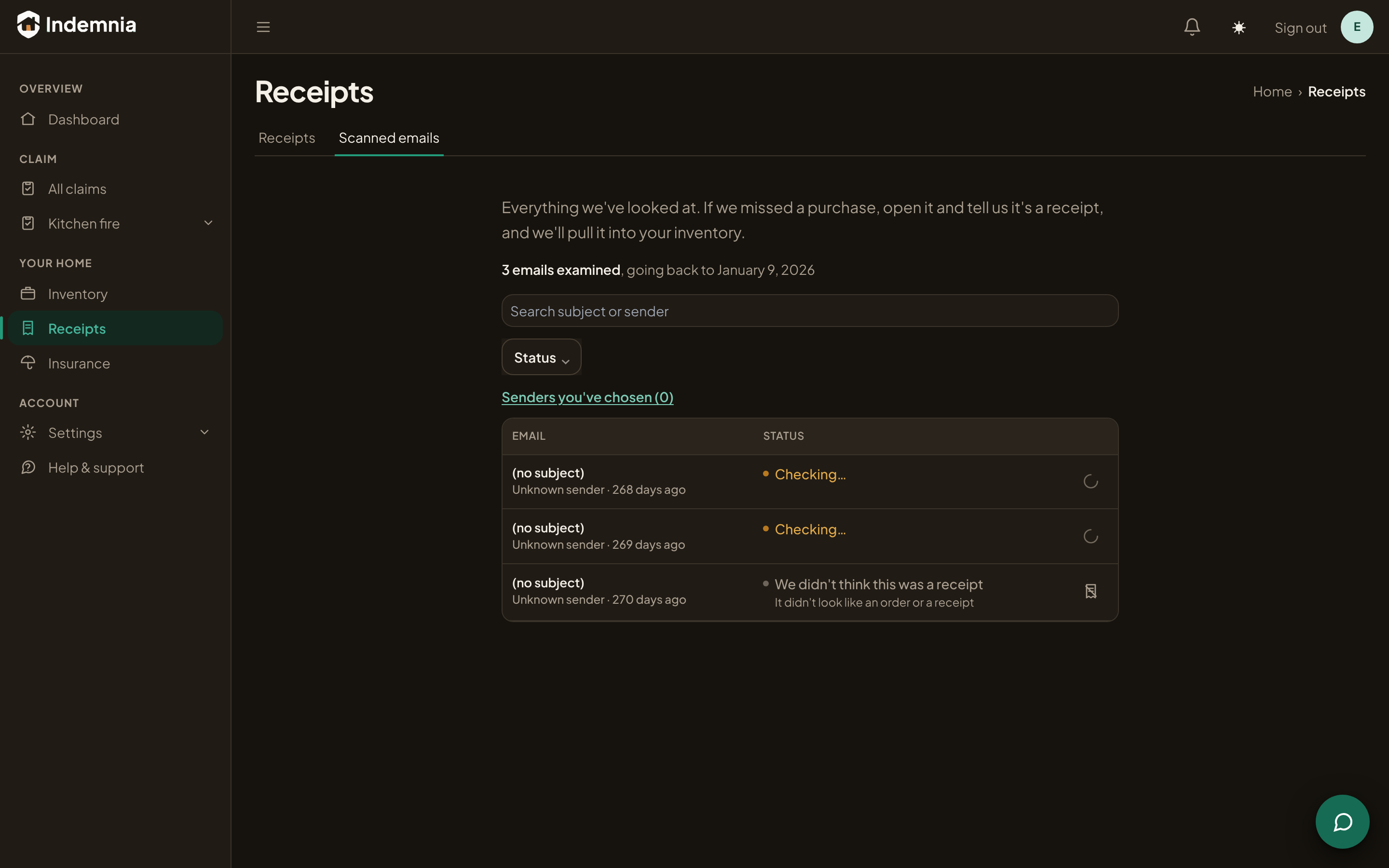
Connect the email where your orders land. Indemnia only reads it and never sends, deletes or changes anything. It turns years of purchase confirmations into dated, priced items. Most people find a few hundred things they had forgotten they bought.
Photograph a room, get a list back
Point your phone at a shelf or a closet. Indemnia identifies what is in the picture and suggests items with make, model and an estimated price. You confirm what is right before any of it counts, which is why the record holds up when someone else is checking it.
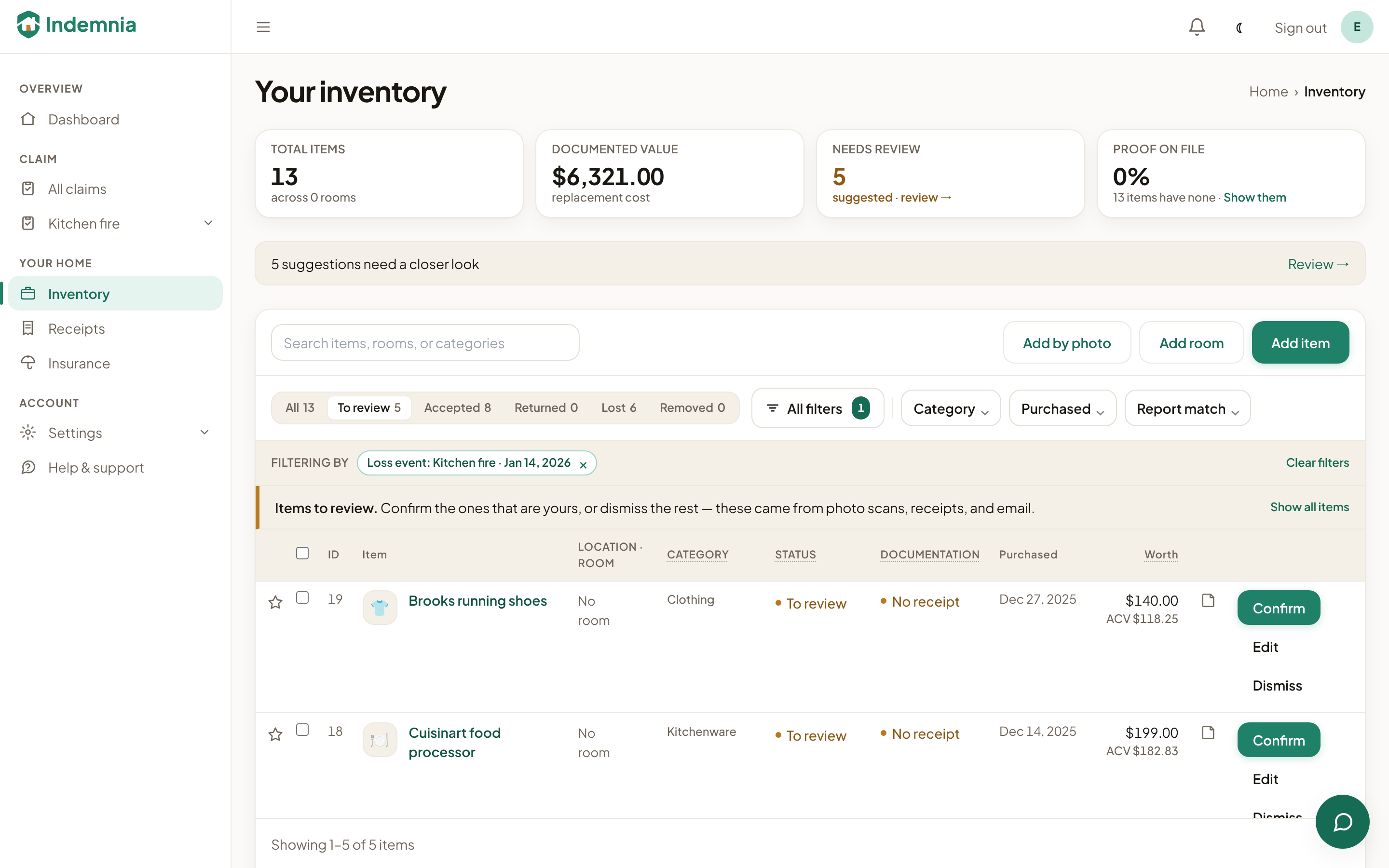
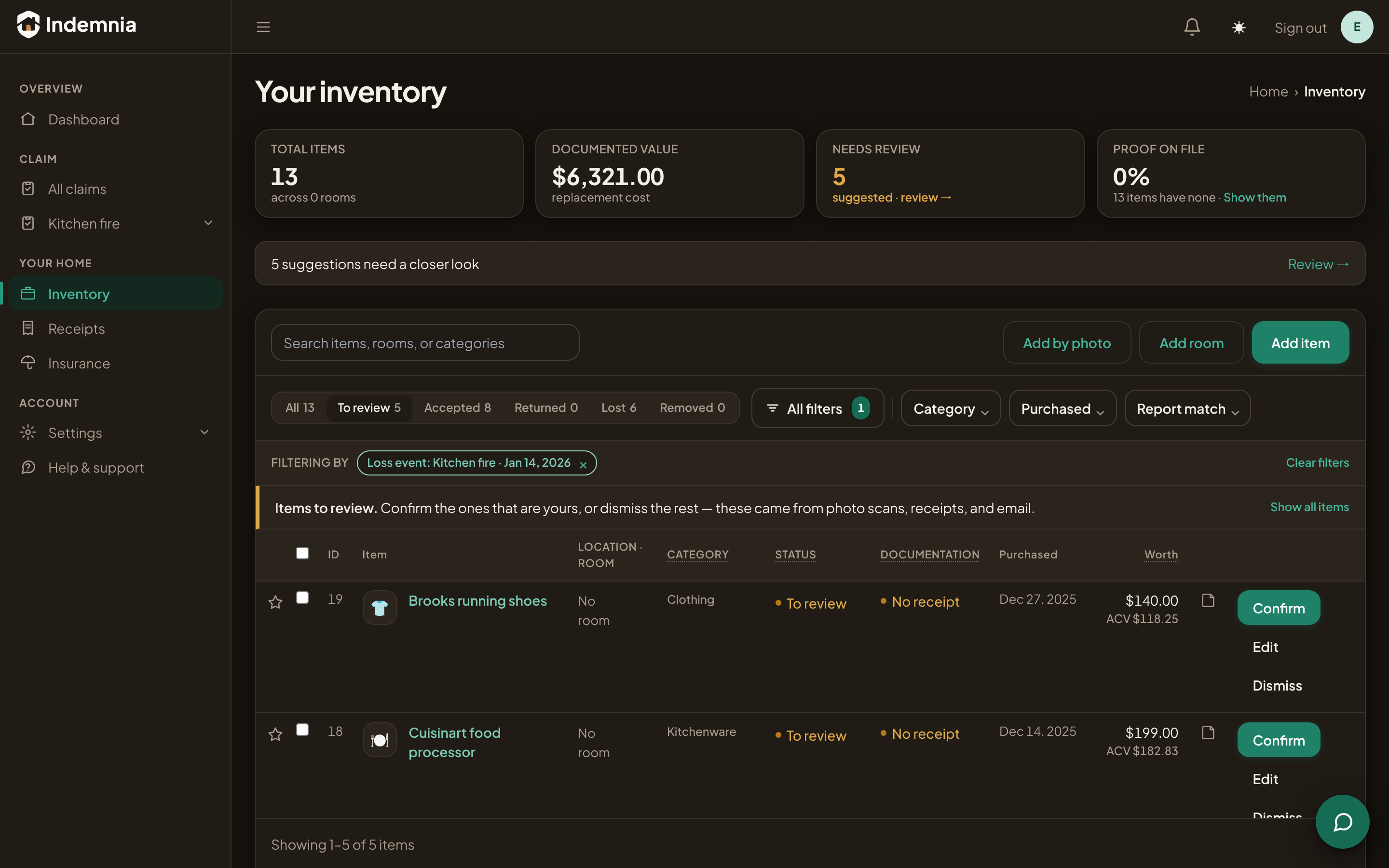
Every line shows its own arithmetic
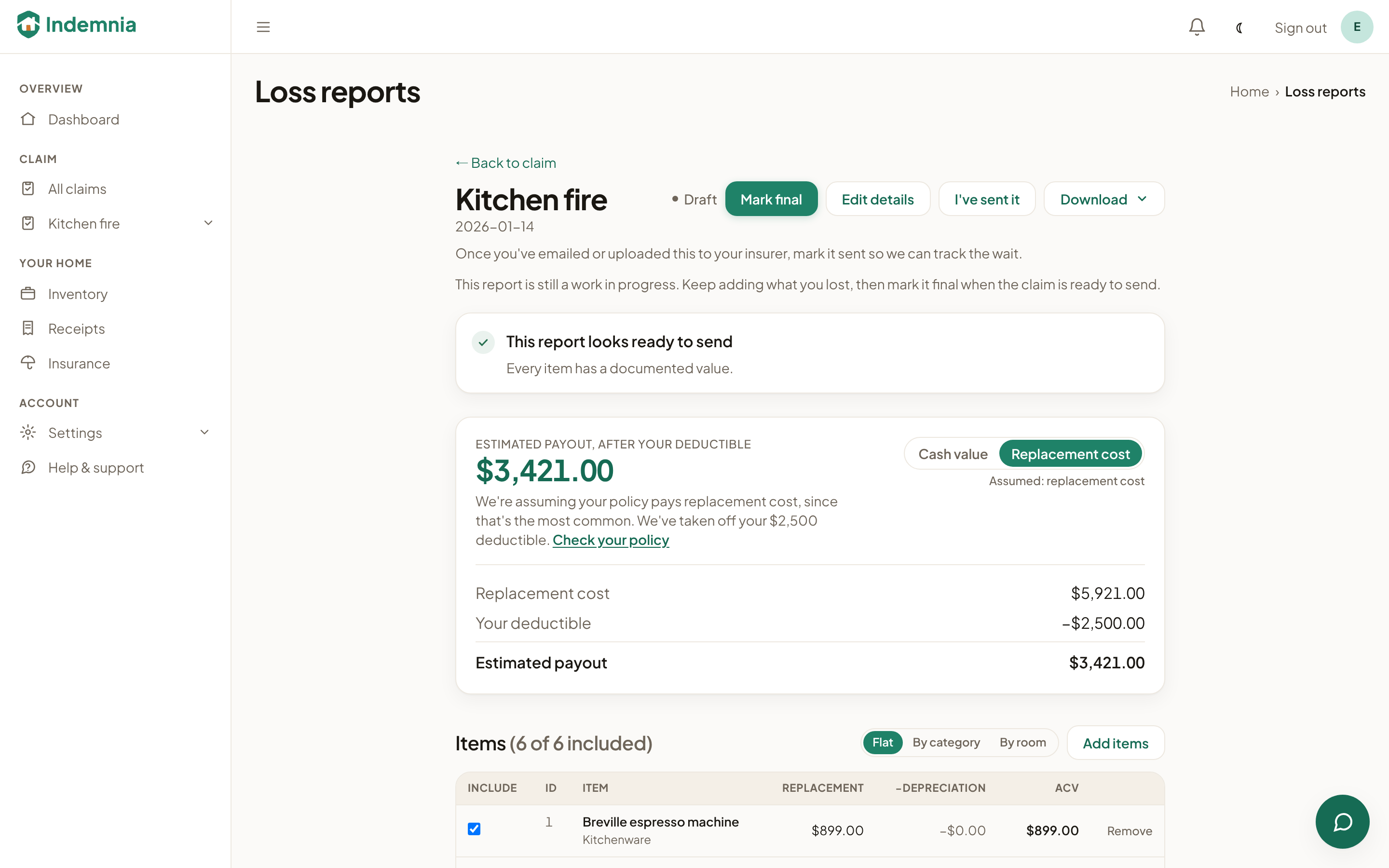
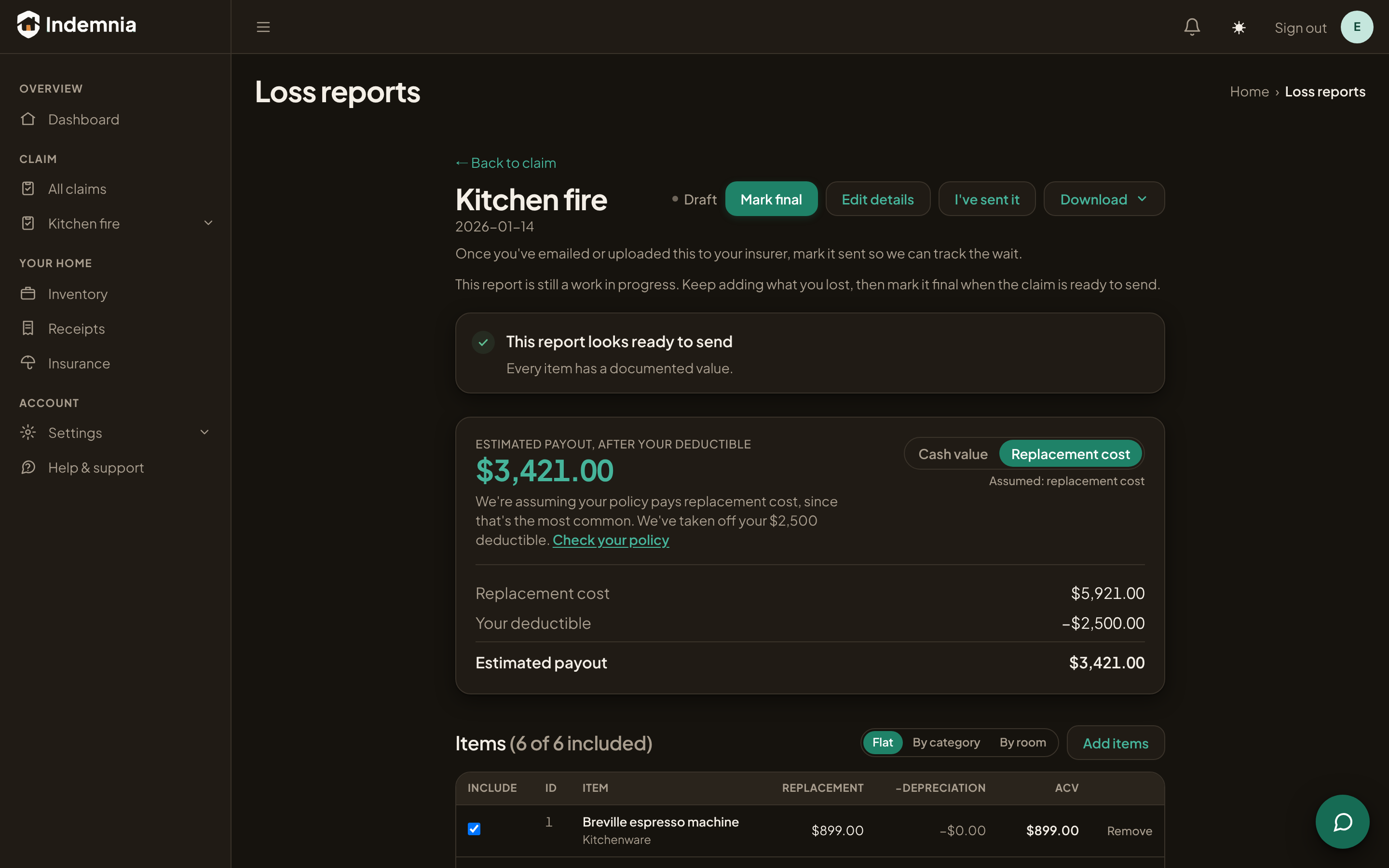
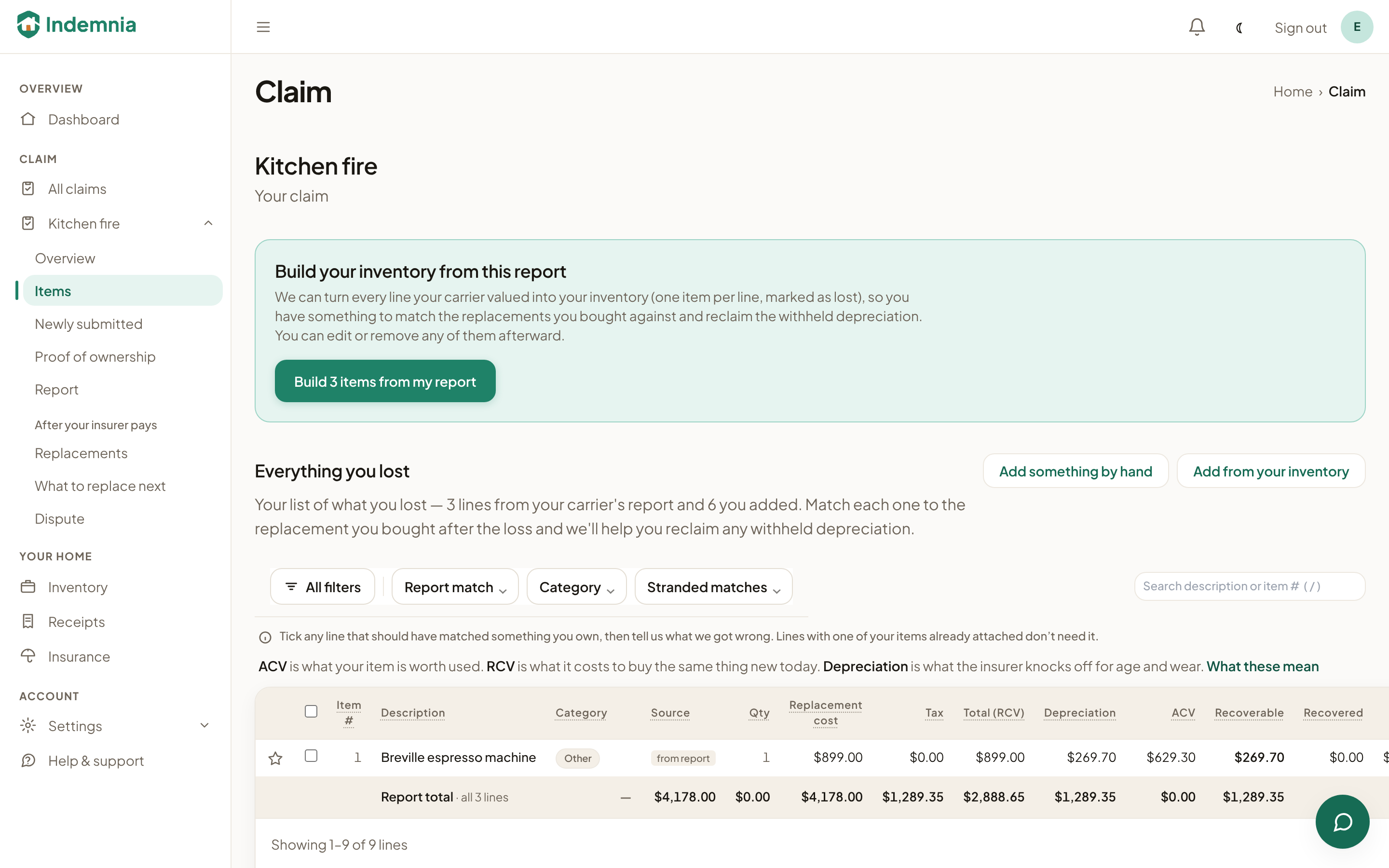
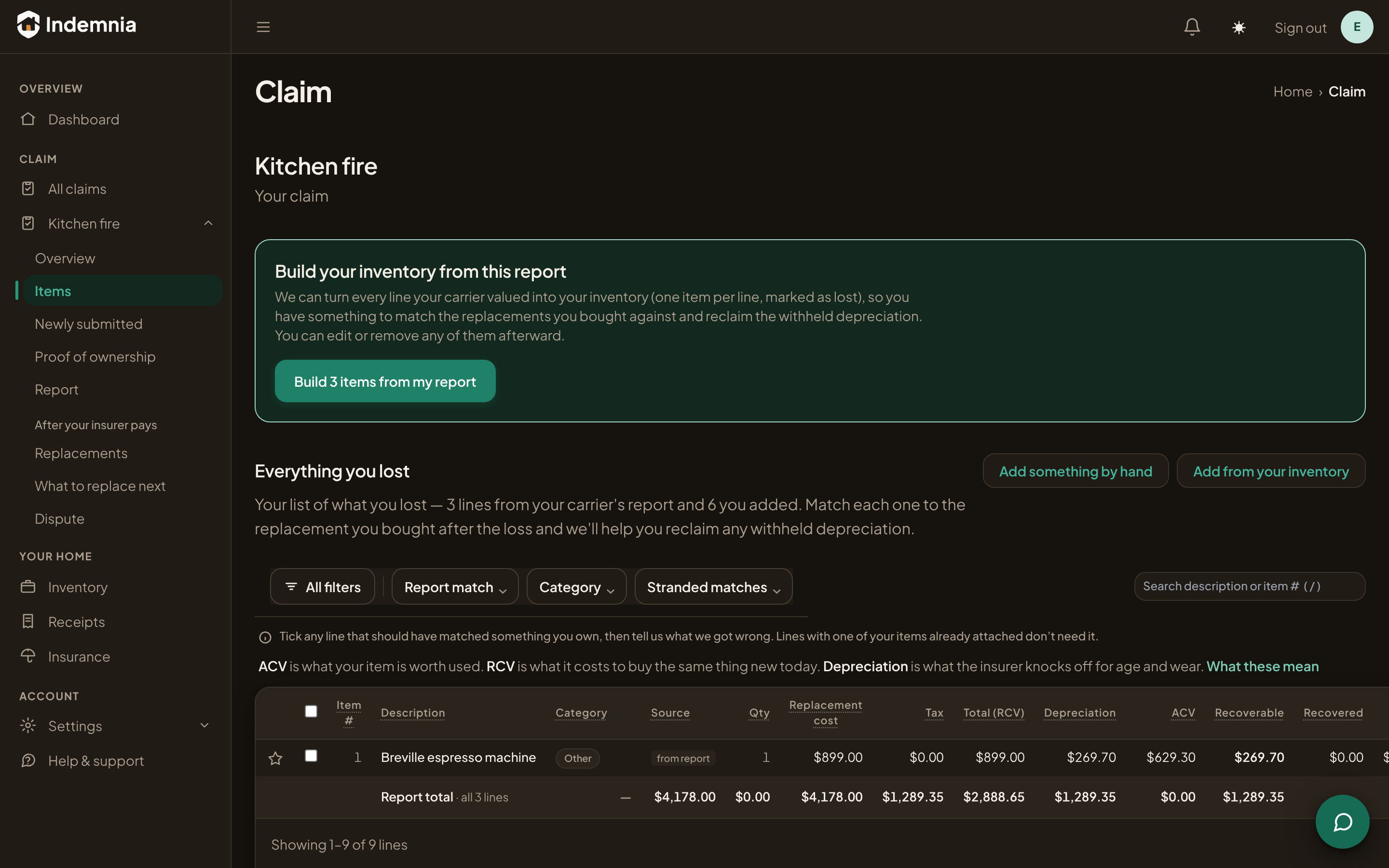
Replacement cost, depreciation, and actual cash value, which is what the item is worth used. Those are the three numbers a claim settles on, and each one traces back to the document it came from rather than to an estimate someone made.
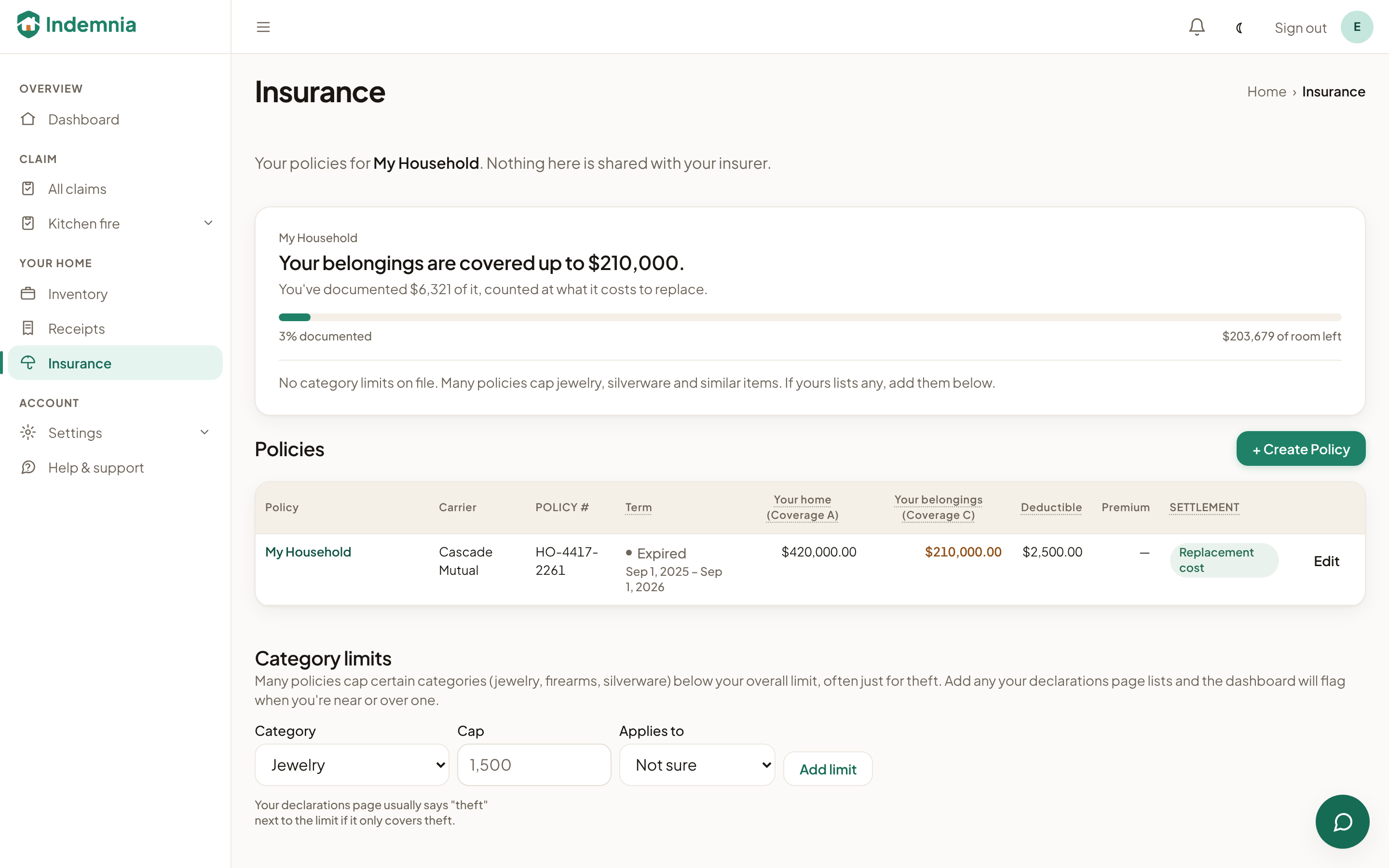
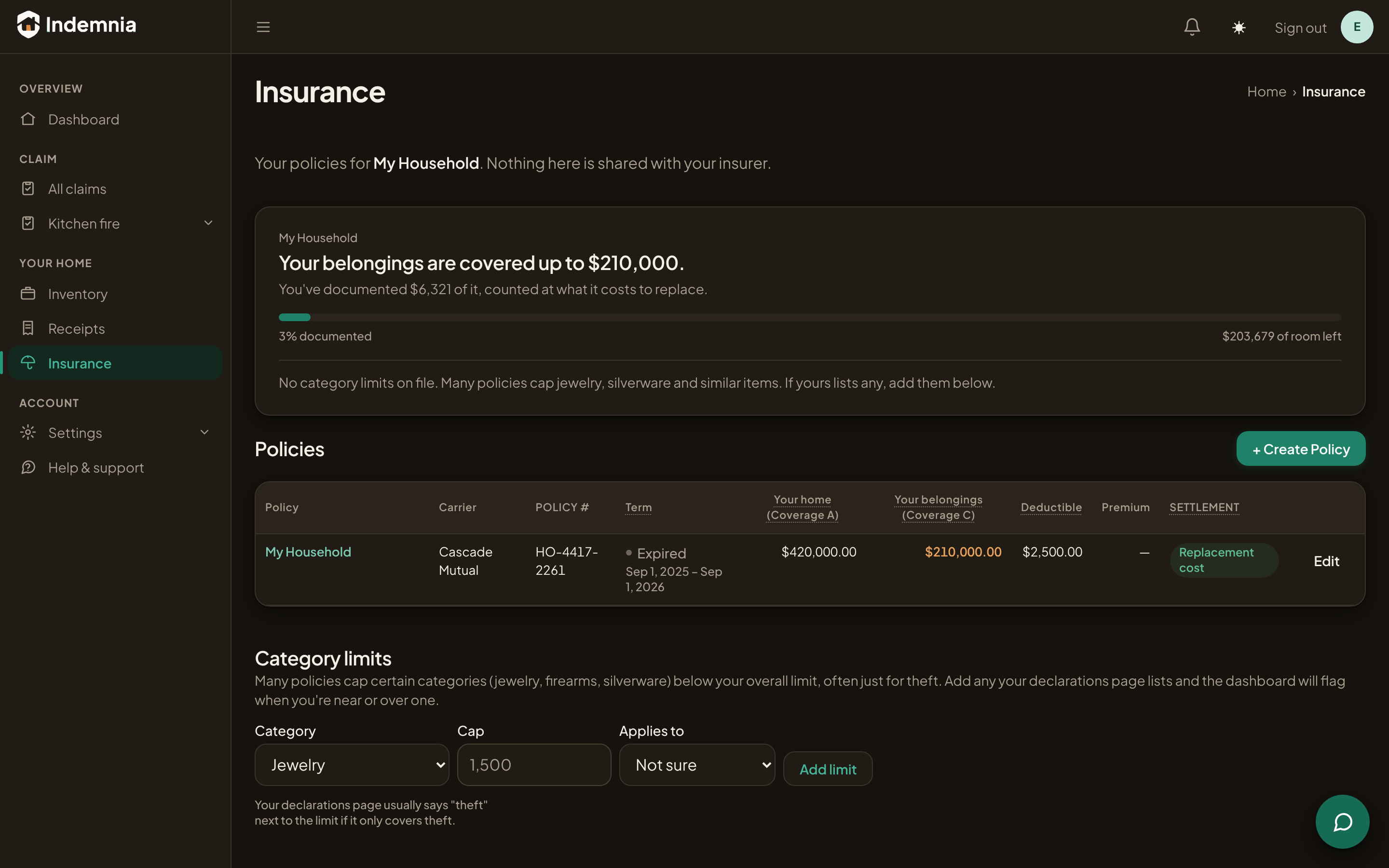
See the gap while you can still do something about it
Indemnia compares what you own against what your policy actually covers, and shows you where the limit falls short. Finding that out in advance is a different conversation from finding it out during a claim.
How it works
Three steps from your inbox to a priced report
Connect your email
We only read. Indemnia turns the purchases already sitting there into a documented record. Nothing to type.
Fill the gaps
Photograph a room, or scan the paper receipt that never had an email. You confirm what is right before it counts.
Get the report
Replacement cost, depreciation and actual cash value per line, with the receipt attached to the line it proves.
If the loss already happened
You can start in the middle of a claim
Most people find us after the fire, not before it. If your carrier has already sent a depreciation schedule, import it and work it line by line. Indemnia shows what each line is worth, what was withheld, and what buying a replacement gets back.
Reconstructing is harder than reviewing. It is also the case the product was built for, rather than one it tolerates.
See what a claim looks like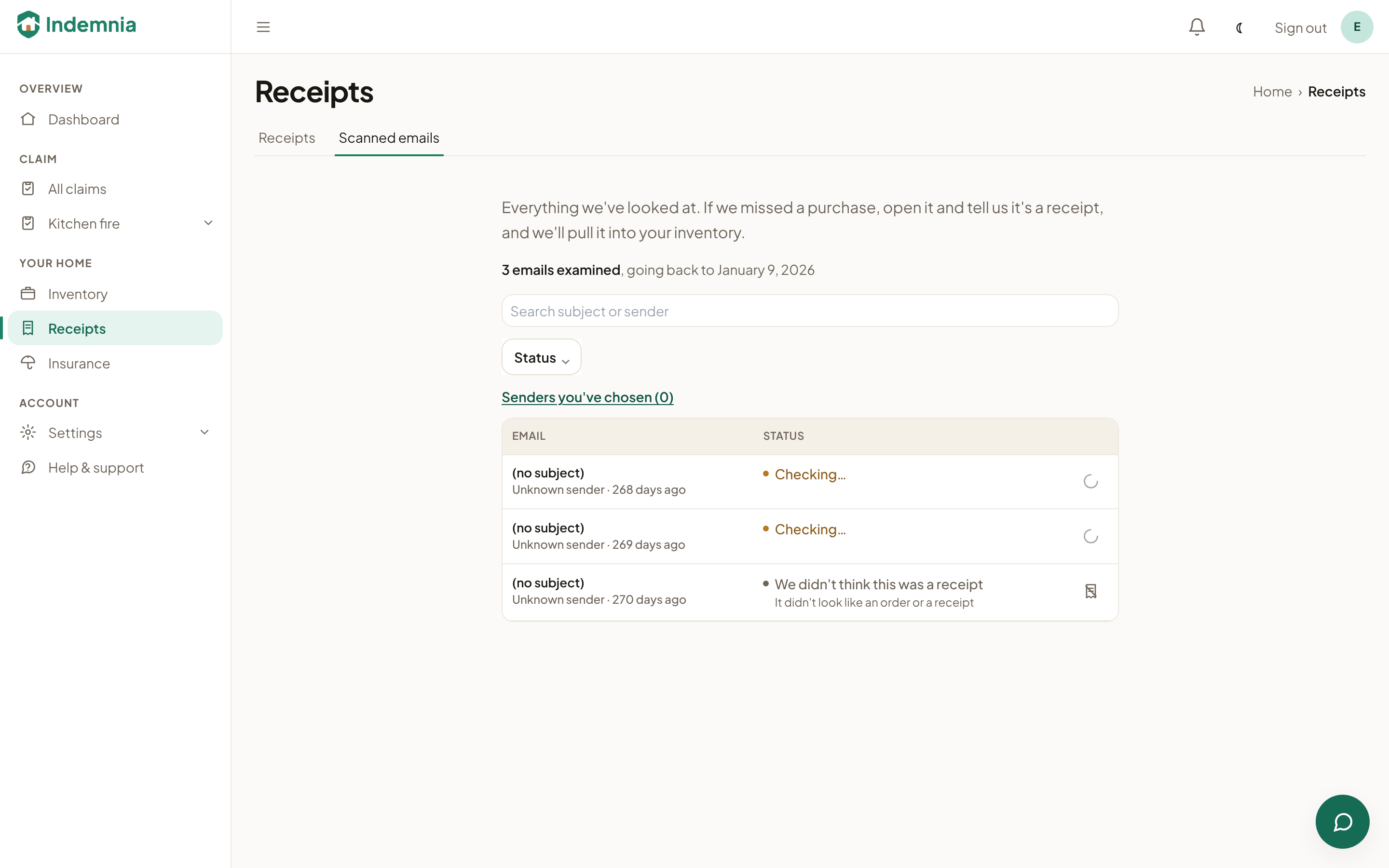
Why we built this
It started with a moving truck fire.
A 54-foot semi carrying everything we owned burned down mid-move. Nothing came back. The claim that followed is the one this company is built around.
Two ways in
Same record, built for who's holding it
The homeowner and adjuster paths split here, once you know what you would be choosing between.
For homeowners
Indemnia Home
Before a loss or during one. Build the record quietly from the receipts you already have, or start now if you are already filing.
- Email receipt aggregation, going back years
- Photo scan and paper receipt scan
- Loss reports and depreciation schedules
- Import a carrier schedule mid-claim
- Export your inventory, receipts and reports, at every tier
For public adjusters
Indemnia for adjusters
Defensible contents schedules, faster. Run every client's inventory in one place and hand over a report that is already backed by documents.
- A household per client, kept separate
- Import the carrier's depreciation schedule
- Reports with proof attached line by line
- Everyone on your team included
The difference
How a contents claim usually goes, and how it goes here
When the list gets built
The usual way
After the loss, from memory, in the worst week of your life
With Indemnia
Before it, from receipts you already have
What is behind each item
The usual way
A description and a guess at what it cost
With Indemnia
A dated receipt and a photo, attached to the line
Who does the typing
The usual way
You, room by room, for weeks
With Indemnia
Indemnia drafts it, you confirm it
How long a contents schedule takes
The usual way
Weeks of back and forth with the carrier
With Indemnia
Days, and it comes out complete
What the adjuster receives
The usual way
A spreadsheet they have to take your word for
With Indemnia
A report where every figure traces to a document
| The usual way | With Indemnia | |
|---|---|---|
| When the list gets built | After the loss, from memory, in the worst week of your life | Before it, from receipts you already have |
| What is behind each item | A description and a guess at what it cost | A dated receipt and a photo, attached to the line |
| Who does the typing | You, room by room, for weeks | Indemnia drafts it, you confirm it |
| How long a contents schedule takes | Weeks of back and forth with the carrier | Days, and it comes out complete |
| What the adjuster receives | A spreadsheet they have to take your word for | A report where every figure traces to a document |
Questions
What people ask before they start
What does it cost?
Nothing to start. The free plan finds your first 150 items for you from your email and photos, anything you type in yourself is unlimited, and there's no card to enter.
Indemnia Home is $249 a year, or $29 a month. It has no item limit, goes back through your whole email history, and adds loss reports and depreciation schedules. Compare the plans.
Is my email safe?
We only read. With Gmail and Outlook the permission itself is read-only, so we can't send, delete or change anything in your mailbox. We store the full message only when it scores as a receipt, and even those stored copies are deleted after 90 days. The receipt data is what stays.
The long version is here, including each mail provider, how to disconnect and what happens when you do.
Will my insurance company accept the report?
Your insurer decides what it accepts, so nobody can promise that for them. What we can tell you is what the report contains: every item with what it cost, when you bought it, how much it has depreciated and what it's worth used, with the receipt or photo behind each line.
That is the itemized list insurers ask for, laid out so an adjuster can check each figure rather than take it on trust. See a sample report.
What if I'm already in a claim?
You can start now. If your carrier has already sent a depreciation schedule, you can import it and work line by line: Indemnia shows what each line is worth, what was withheld as depreciation, and what buying a replacement would recover.
Starting mid-claim is harder than starting before one, because you are reconstructing rather than reviewing. It is also what most people are doing when they find us, and it is a case the product is built for rather than one it tolerates.
What if I have no receipts?
Most people think they have none and have more than they expect: years of order confirmations sitting in an inbox nobody has searched. That is the first thing Indemnia looks through, and it usually finds a few hundred things you had forgotten you bought.
For everything email never saw, you add it: photograph a room and we identify what is in it, scan a paper receipt, or type an item in. A record built from a mix of proof and honest recollection is normal. The point is that the parts you can prove are proven.
Which email accounts work?
Gmail, Outlook and Yahoo. Most people have their order confirmations in one of those.
If yours are somewhere else, such as iCloud Mail, you can still add receipts by photographing or uploading them, and we read them the same way. How your email is handled.
Start your inventory
It's free to begin, and there's no card. Most people start with the receipts already sitting in their inbox.
Free for your first 150 items. Everything you add is yours to download, on any plan.
Would rather be walked through it? schedule a demo.