


Loss reports
What a loss report should show, and how every number gets there.
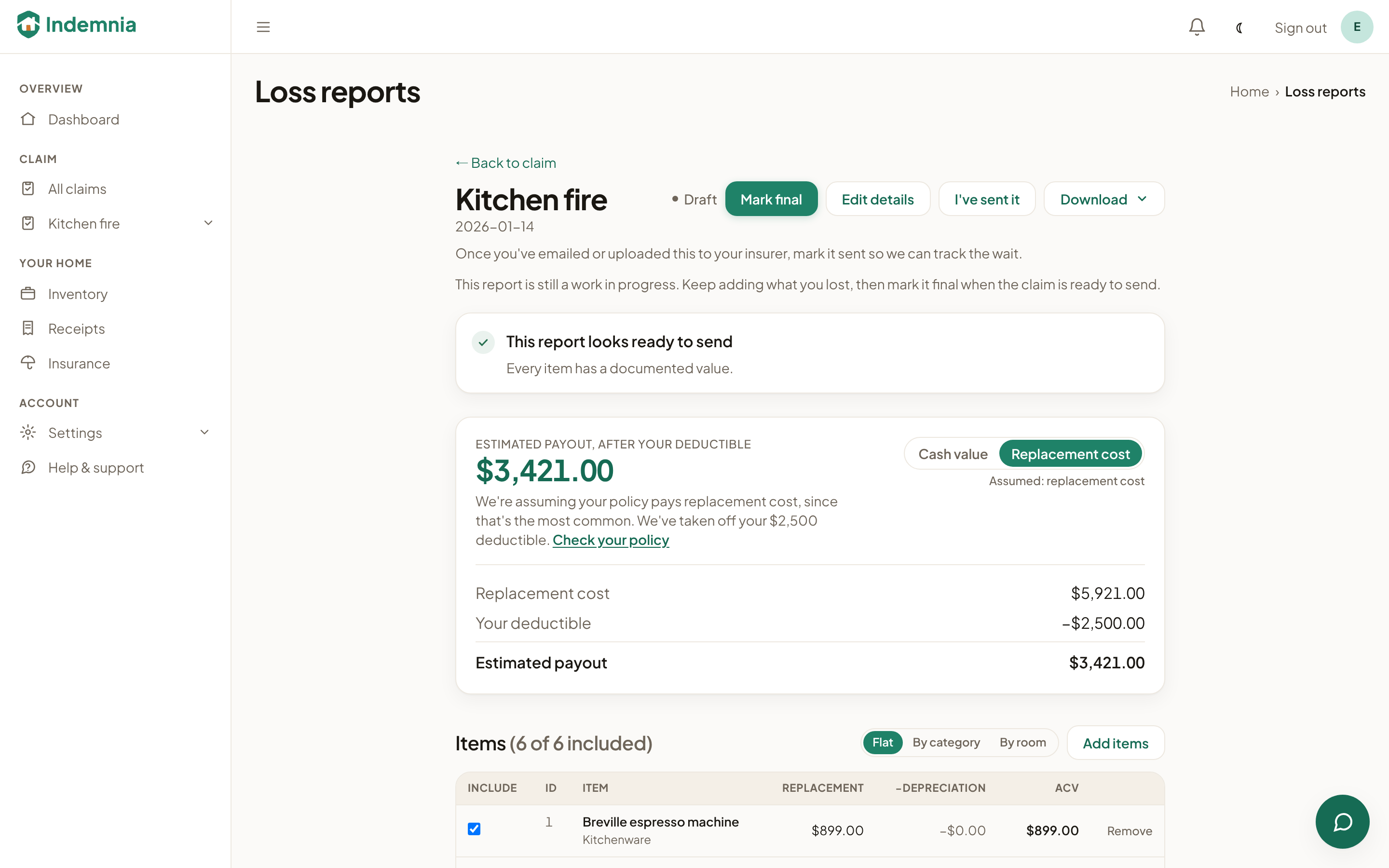
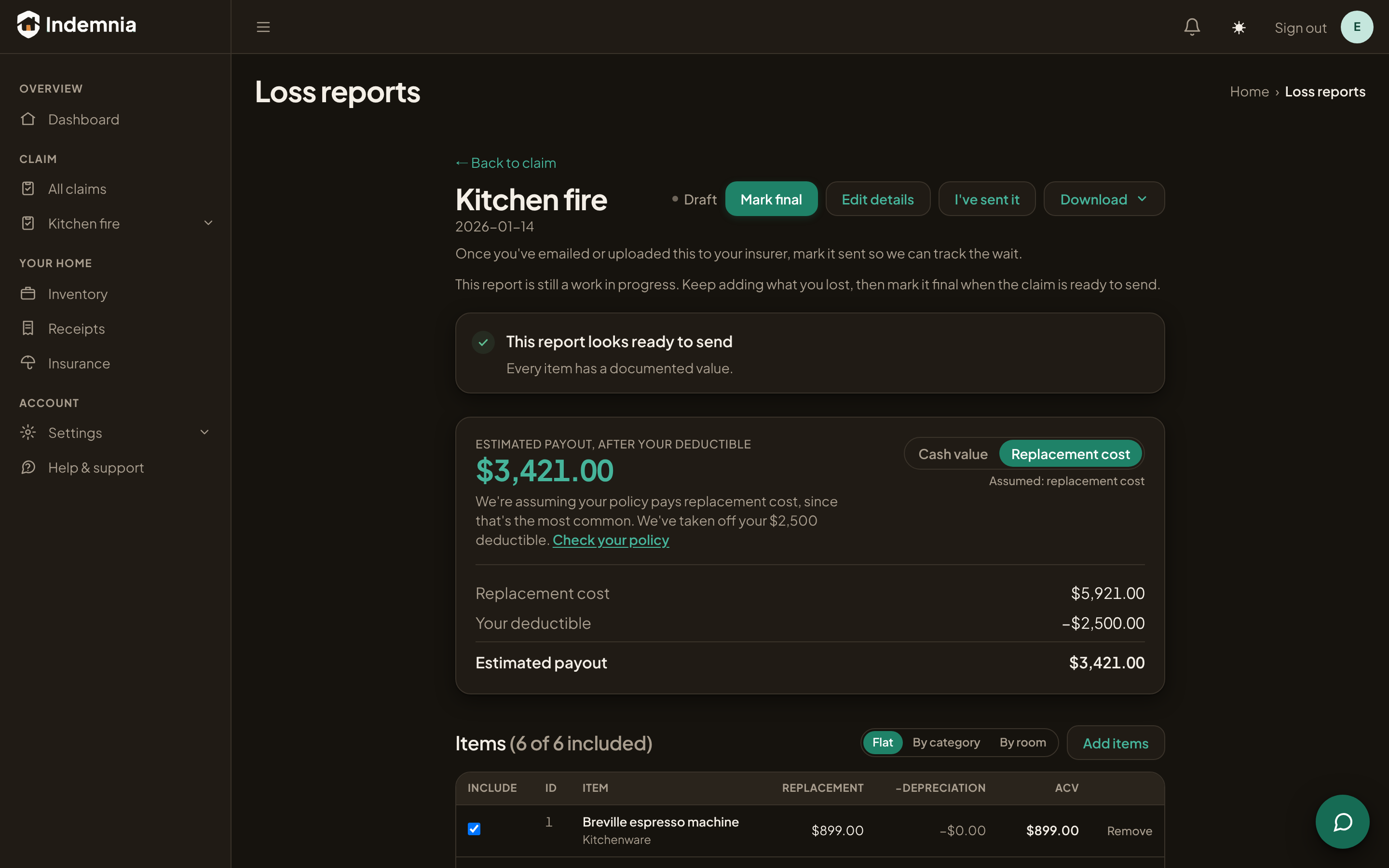
Your insurer settles your belongings from a list. This is what goes on ours, why each column is there, and the exact arithmetic behind each figure, so anyone can check it.
Thirty minutes, screen shared. We'll open a report with you.
Replacement cost · Depreciation · Actual cash value · Every line, with the method shown
What's in it
Three parts, in the order an adjuster reads them
Page 1
An index
Where each part starts, so a page pulled out of the stack still makes sense.
Summary
The estimated payout
Replacement cost, sales tax and shipping, depreciation, actual cash value, and what you can claim back after replacing things.
Schedule
Every item, line by line
The depreciation schedule. Column headings repeat on every page, and the total closes the last one.
The schedule
Nine columns, and why each one is there
A schedule an adjuster can check is one they can agree with. Every column answers a question they'd otherwise have to ask you.
1. 55-inch televisionelectronics
2. Sofafurniture
3. Stand mixerkitchenware
EST.4. Winter coatclothing
5. Area rugfurniture
| ID | Item | Bought | Age / life, yrs | Proof | Basis | Replacement | Depreciation | ACV |
|---|---|---|---|---|---|---|---|---|
| 1 | 55-inch televisionelectronics | 06/01/2024 | 2.0 / 5 | Receipt, photo | $899.00 | −$359.60 | $539.40 | |
| 2 | Sofafurniture | ~06/2023 | 3.0 / 15 | Photo | $1,450.00 | −$290.00 | $1,160.00 | |
| 3 | Stand mixerkitchenware | 06/01/2022 | 4.0 / 10 | None | EST. | $449.00 | −$179.60 | $269.40 |
| 4 | Winter coatclothing | 06/01/2020 | 6.0 / 5 | Receipt | $220.00 | −$220.00 | $0.00 | |
| 5 | Area rugfurniture | — | — / 15 | Photo | $640.00 | NO DATE | $640.00 | |
| Total (5 items) | $3,658.00 | −$1,049.20 | $2,608.80 |
Example lines, not a real household. Worked out with the same code the report uses, taking each item's age in whole years.
Reading a line
The Proof column says what's on file for each line. The receipts and photos themselves go in the proof package that travels with the schedule, matched to the lines they prove.
- ID
- A number for every line, so you and the adjuster can talk about “line 14” and mean the same thing.
- Item and category
- What it is, and the category that sets how fast it wears out. Quantity shows here when there's more than one.
- Bought
- When you bought it. If you only knew roughly, it shows the month with a ~ in front.
- Age and useful life
- How old the item is, in years, next to how long things in its category are expected to last. Depreciation is replacement × age ÷ life, so the adjuster can check every figure from this column.
- Proof
- What's on file for the item: a receipt, a photo, both, or none.
- Basis
- Flags anything to look at twice. EST. means the value is an estimate rather than a price from a receipt. “Depreciated value” means the item settles at its used value under your policy, an antique for example, and a footnote cites the clause.
- Replacement
- What it costs to buy the same thing new today.
- Depreciation
- What comes off for age and wear. NO DATE means we don't know when it was bought, so nothing comes off, and the line says so instead of printing a confident $0.00.
- ACV
- Actual cash value: replacement minus depreciation. What the item is worth used.
The three numbers
What it costs new, what comes off, what it's worth
Replacement cost
$899.00
The same television, new, today.
Depreciation
−$359.60
Two years into a five-year life: 40% off.
Actual cash value
$539.40
What it's worth used. The insurer pays this first.
If your policy pays replacement cost, the $359.60 isn't gone. It's recoverable depreciation, and you claim it back once you've bought the replacement. The summary page shows that figure for the whole report, as the amount held back until you replace.
The method
How depreciation is worked out
Every category has a useful life: how many years something like it is expected to last. An item loses an equal share of its value each year of that life. Halfway through, it's worth half. At the end, the schedule shows $0.
Age is counted from the purchase date on the receipt to the date of the report. If there's no purchase date, nothing comes off, and the line says NO DATE rather than pretending.
The exact method, for adjusters
Straight-line, per item:
age          = (report date − purchase date) in days ÷ 365.25
rate         = min(age ÷ useful life, 1)
depreciation = replacement cost × rate
ACV          = replacement cost − depreciation
Rounded to the cent once, at the end, not at each step. No salvage floor is applied, so an item past its useful life reaches $0. Some insurers keep a minimum value on every item. Where yours does, their figure for an old item can be higher than ours, and the reconciliation view shows you exactly which lines differ.
Worked example: a $899.00 television, 2.0 years old, electronics (5-year life). Rate 2.0 ÷ 5 = 0.40. Depreciation $899.00 × 0.40 = $359.60. ACV $899.00 − $359.60 = $539.40. Because age is counted in days, a real report dated exactly two calendar years after purchase shows $539.65: 730 days is a little under 2.0 years.
Try it with your own item in our depreciation calculator.
Useful life by category
Already have their numbers?
Put their schedule next to yours
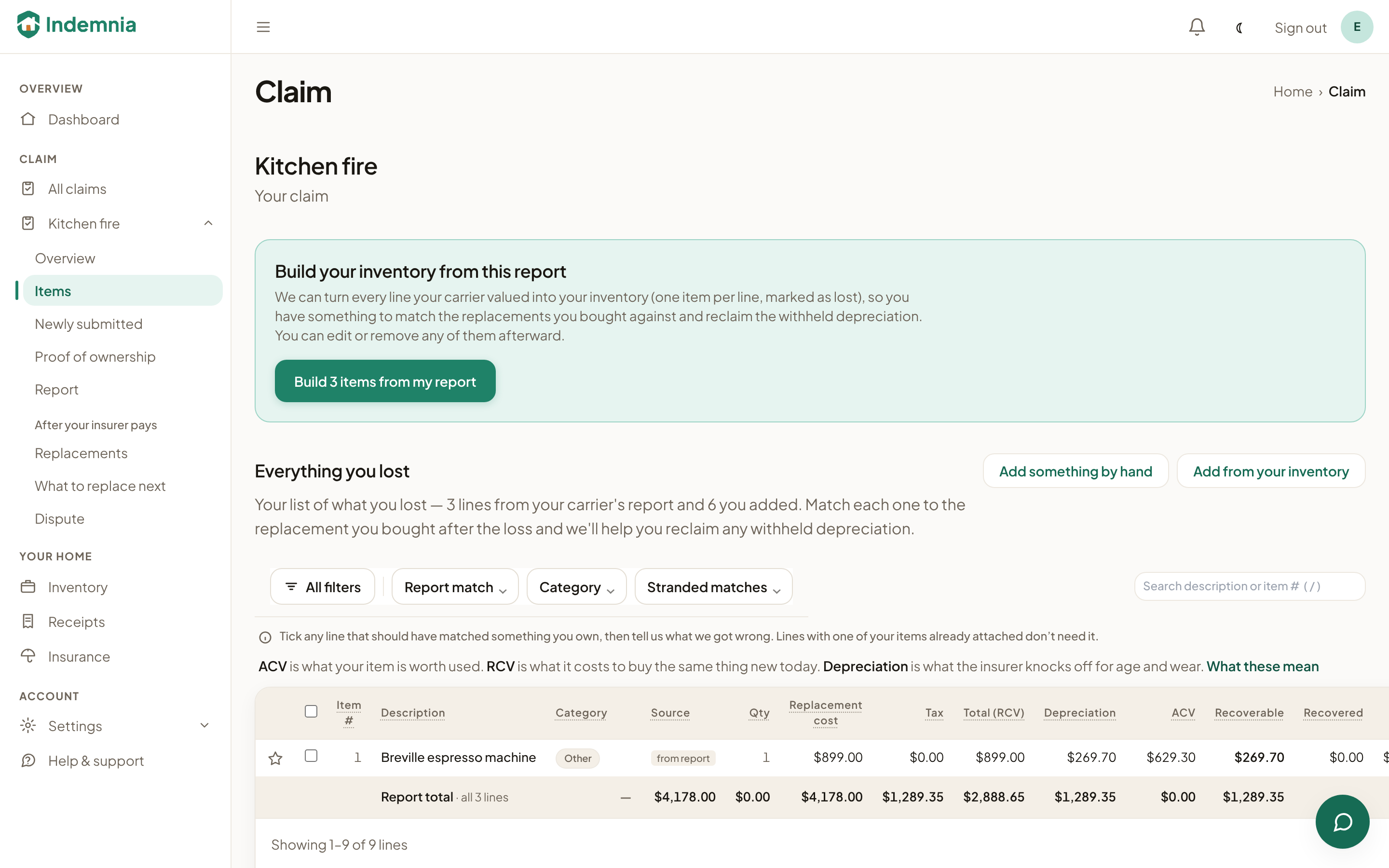
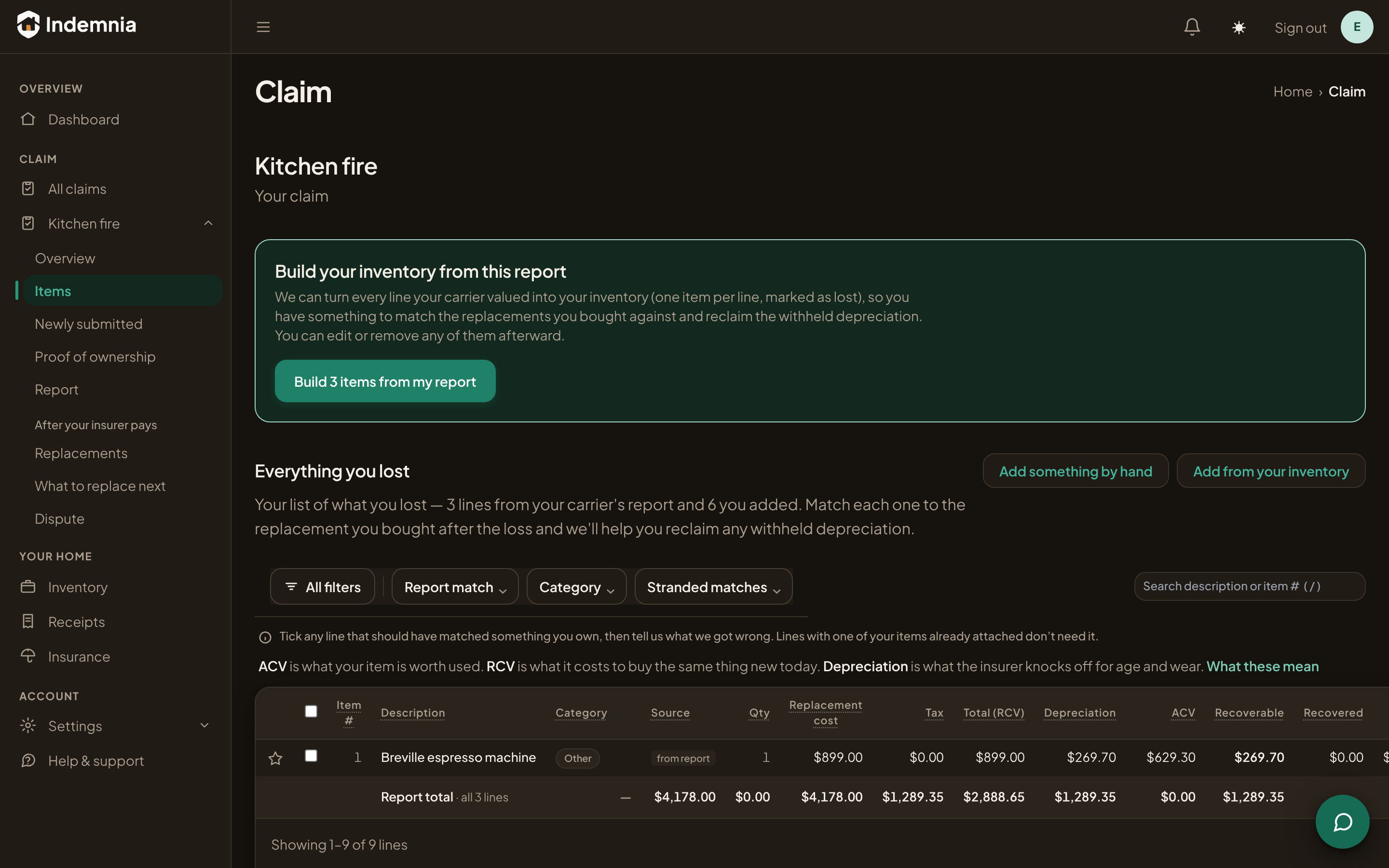
If your insurer has sent a depreciation schedule, import it. Indemnia reads it back line by line, matches each line to your items, and shows where their figures and yours part ways, and what replacing each item would recover.
- Their depreciation schedule, imported
- Recoverable depreciation tracked against each line's cap
- A proof package to send with it
What the report won't do
It won't make up a date or dress up a guess. A line with no purchase date says NO DATE, and a value we estimated is marked EST., so you and the adjuster both know which figures to look at twice.